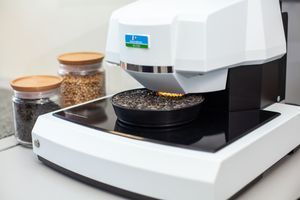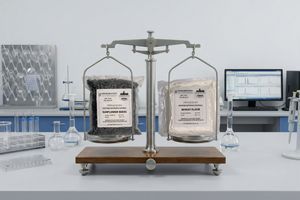
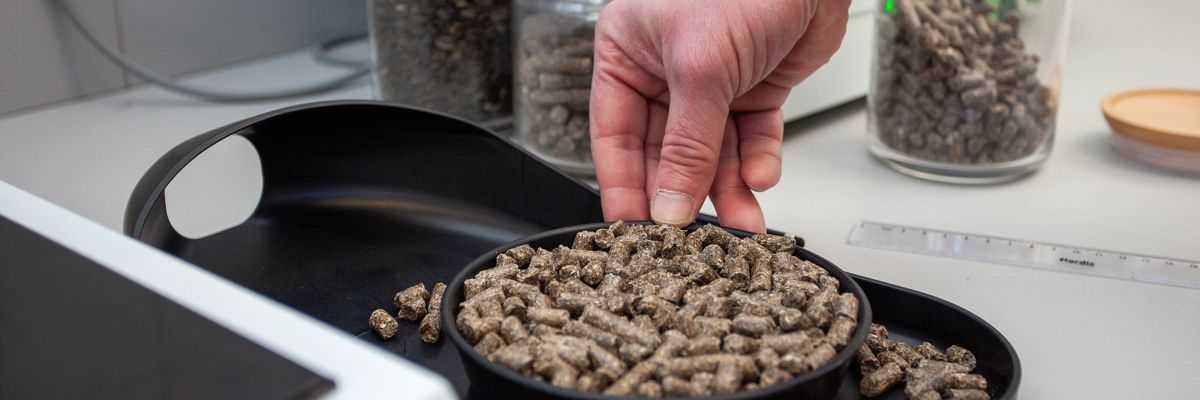
When a laboratory transitions to indirect methods of analyzing the quality of grain and its by-products using near-infrared (NIR) spectroscopy, the equipment is not always adjusted using proper reference materials, despite the requirements of manufacturer instructions and international standards. Often, after the initial factory calibration, analyzers are configured using samples of inadequate quality.
A control sample of grain (meal, cake, feed) only serves as a true standard if strict conditions are met, including:
-
Manufacturer Competence: The availability of suitable reference materials, qualified personnel, and a robust quality control system at every stage.
-
Preparation: Meticulous sampling, sieving, and homogenization (mixing) of the materials.
-
Certification: Verification in accredited laboratories with the issuance of a formal certificate for each reference sample (wheat, soy, sunflower, etc.).
-
Physical Conditions: Strict adherence to storage (temperature, humidity, vacuum packaging) and transportation requirements.
Many modern NIR analyzers offer a calibration transfer feature. This is highly convenient, especially for large agricultural holdings with multiple laboratories spread hundreds of miles apart. However, practice shows that such transfers often result in a significant drop in measurement accuracy. The primary reason for this is the disruption of metrological traceability.
This occurs because no two measuring devices are entirely identical. Even if one analyzer is perfectly calibrated using standard samples, transferring its data to another device will not guarantee a precise result. The slightest technical variations—such as the angle of the diffraction grating, manufacturing tolerances of the photodetector, or the aging of the infrared lamp—will introduce errors.
Understanding Metrological Traceability
According to fundamental metrological definitions, traceability is the property of a measurement result whereby the result can be related to an international reference through a documented, unbroken chain of calibrations, each contributing to the overall measurement uncertainty.
To make this easier to understand, consider a simple school ruler. True primary measurement standards are kept under strict, sterile laboratory conditions (much like reference grain samples in vacuum bags stored in a refrigerator). However, a standard school ruler has a significant margin of error because the path from the primary standard to the plastic manufacturing mold is far too long. Errors accumulate at every stage of production, making metrological traceability impossible to track. Conversely, in scientific measurements where fractions of a micron matter, traceability is absolutely essential—along with reliable knowledge of the uncertainty added at each calibration step.
Uncertainty in Reference Samples
If samples are ordered without an accompanying certificate of analysis (meaning no documentation and no quality system), metrological traceability simply does not exist.
How should it work? The certificate for a wheat control sample will state the protein content—for example, 12.35%. Crucially, the buyer is also provided with the metrological uncertainty, such as ± 0.18%. Where does this uncertainty come from? Even in accredited laboratories, high-precision equipment is not flawless. Uncertainty is also influenced by:
-
Indoor microclimate conditions.
-
The quality of sample preparation (which depends entirely on the manufacturer).
-
Imperfections in the reference methodology itself.
Therefore, when adjusting the grain analyzer, the user knows with absolute certainty that the actual protein content in the sample lies within the interval of 12.17% to 12.53%. While it would be ideal for metrological uncertainty to be zero, this is physically impossible. This metrological characteristic is closely tied to probability. The manufacturer of the reference standard guarantees that the true value safely resides within this specified range.
The Calibration Hierarchy and Transfer Risks
Using standard samples from a certified manufacturer, verified across multiple independent laboratories (proficiency testing), is the only way to guarantee metrological traceability.
Now, imagine an NIR analyzer is properly calibrated using a primary standard (the certified sample). To save money on buying additional samples, the laboratory decides to use the calibration transfer feature for other analyzers. In this scenario, the first device acts as a "secondary standard," and the device receiving the transfer adds its own technical error to the equation. This is known as the hierarchy of calibrations.
The fundamental issue is that after a calibration transfer, the total metrological uncertainty increases significantly, drastically lowering the accuracy of the second analyzer. An unreliable protein result can lead to massive financial losses for a grain trading company. Taking this risk is highly illogical when considering the cost: the price of a high-quality certified sample is typically less than 1% of the cost of the NIR analyzer itself.
Core metrological concepts to remember:
-
Traceability.
-
Measurement Uncertainty.
-
Hierarchy of Calibrations.