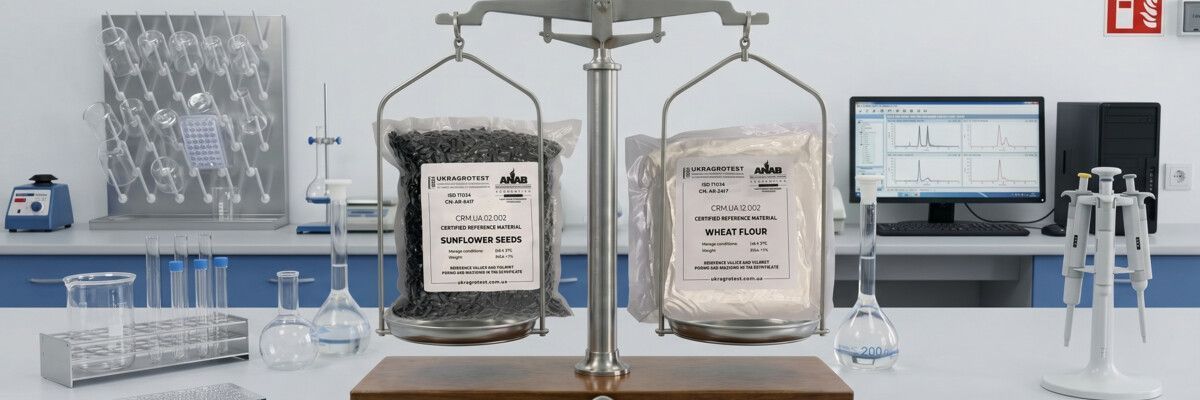
In a modern laboratory, precision is everything. Fair grain pricing, corporate reputation, and trust in international markets all depend on it. The foundation of this accuracy lies in proper calibration and regular equipment verification, which fundamentally require control materials.
But are all samples labeled "standard" or "control" the same? Absolutely not. There is a strict hierarchy, and choosing the wrong type can lead to inaccurate results and financial losses. Let's explore the differences between them, moving from basic materials to the ultimate "gold standard."
Level 1: Quality Control Materials (QCM)
This is the baseline level that any laboratory can prepare in-house.
-
What is it? A sample prepared by the laboratory for its own use (in-house) from available working material.
-
How is the value determined? The laboratory runs multiple analyses on this sample and assigns it a "target" or "internal" value.
-
Standard: Guidelines for their preparation are outlined in ISO Guide 80.
-
Purpose: Strictly for routine daily internal control. For example, to check if the instrument's settings have drifted compared to the previous day.
-
Limitations: This is not a reference standard. Its value lacks external verification, metrological traceability, and calculated uncertainty. They must never be used for calibration.
Level 2: Reference Materials (RM) from an Accredited Laboratory (ISO 17025)
This is the next, significantly more reliable step.
-
What is it? A sample (RM) that has been analyzed and attested by a single laboratory accredited to ISO/IEC 17025.
-
How is the value determined? A competent laboratory issues a formal report with the measurement result (attested value).
-
Purpose: Quality monitoring, method performance testing.
-
Limitations: While the laboratory is proven to be competent (as confirmed by ISO 17025), the result still relies on data from just one organization. This standard does not cover the sample production process, meaning it does not guarantee a comprehensive evaluation of homogeneity or long-term stability, unlike a CRM.
Level 3: RM from Proficiency Testing (PT / ISO 17043)
These samples are frequently mistaken for calibration standards, but their purpose is entirely different.
-
What is it? Samples distributed by proficiency testing (PT) providers to "test" participating laboratories.
-
Standard: The PT provider organizing the program is accredited to ISO/IEC 17043.
-
How is the value determined? A "consensus value" is used—the statistically averaged result of all laboratories participating in the test.
-
Purpose: Exclusively for assessing laboratory competence (i.e., to "pass the test").
-
Limitations: A consensus value is not a "true" or reference value. It is simply a "group average." Its accuracy depends entirely on the overall skill level of all participants. Calibrating an instrument with such a sample is like tuning your equipment to the average of other laboratories without knowing if they were actually correct.
Level 4: Certified Reference Materials (CRM)
This is the highest tier in the hierarchy, serving as the only true benchmark for your laboratory.
-
What is it? A material produced by an organization whose competence as a manufacturer is confirmed by formal international accreditation.
-
Standard: The manufacturer is accredited to ISO 17034.
-
How is the value determined? It holds a "certified value" established by the manufacturer before the sample is sold. It is obtained using high-precision methods, confirmed through interlaboratory testing, and has two critical parameters:
-
Metrological Traceability: The value is securely "linked" to recognized international standards.
-
Uncertainty: The manufacturer provides a strictly calculated range (e.g., "± 0.1%") that guarantees the reliability of this value.
-
-
Purpose: Instrument calibration, validation (verification) of measurement methods, and rigorous evaluation of result accuracy.